
Five-Animal Play Qigong and Five-Element & Five-Zang Theory
五禽戏与五行五脏学说
Kevin W Chen, Ph.D. MPH
Wuqinxi, or Five-Animal Play is one of the important Qigong exercises in traditional Chinese wellness practice. Its founder, Hua Tuo (about 145-208), was born in Qiqiao County, Peiguo (now Bozhou, Anhui province) at the end of the Eastern Han Dynasty. He wrote a lot works in his life, but they were all lost in the history. The current biographies of The Chinese Classic and the Secret Biography of Dr. Hua Tuo are all done by using his name.
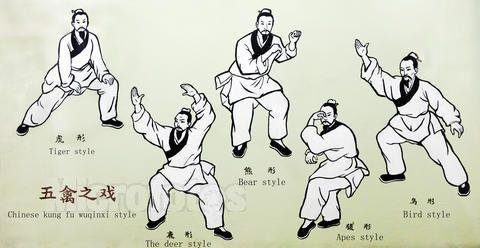
Hua Tuo created the Five-Animal Play based on the “Two-Animal play” in Zhuangzi. According to Hua Tuo’s Biography of Fangshu in the Book of the Later Han dynasty, “I have an art called the Play of Five Animals: the tiger is one, the deer is two, the bear is three, the ape is four, and the bird is five. They can be used to eliminate disease, and to benefit the foot, as a guiding exercise. When the body has not been feeling well, start to make an animal play, happy but sweat, because of the power from the animal, the body is light and wants to eat. By practicing it, one was more than ninety years old; his eyes and ears were wise and his teeth were firm.”
In 2001, after the establishment of the Center for Health Qigong Management in The General Administration of Sports of China, Shanghai Institute of Sport commissioned the digging, sorting and research of Wuqinxi (Five-Animal Play), and compiled the Health Qigong Wuqinxi, which was published by People’s Sports Publishing House in 2003. “Health Qigong • Wuqinxi” its action choreography, reflecting the order appeared in 《Three Kingdom》, which is the tiger, deer, bear, ape and bird; the number of action in accordance with the description of Tao Hongjing’s Record of Nurturing Spirit and Prolonging life. Every play has two actions, a total of ten actions. They simulate respectively the tiger’s brave and strength, the deer’s ease and comfort, the bear’s calmness and stable, the ape’s dexterity and flexibility, and the bird’s lightness and quickness, making every effort to contain the spirit of “five animals”.

Wuqinxi reflects the full life state of the five kinds of animals, their variation in living habits, posture, as well as the Yin-yang characteristics, such as tiger’s strong and masculine, deer’s The quick and alert, ape’s clever and dexterity, bear’s calm and steady, and the crane’s easy and lightness. Its core philosophy is grounded in the Five-Element (Wood, Fire, Earth, Metal, Water) and Zang-Fu (Liver, Heart, Spleen, Lung, Kidney) theories of traditional Chinese medicine (TCM). The Five Elements correspond to the Zang-organs as follows: Liver-Wood, Heart-Fire, Spleen-Earth, Lung-Metal, and Kidney-Water. By imitating the animals’ postures and rhythms, the exercises regulate qi and blood flow in the corresponding organs, promoting balance and disease prevention.
Here is a detailed description of one explanations to help reader to practice Wuqinxi better:
Tiger play: Tiger belongs to Wood in the five-element system, corresponding to the Liver as its primary organ.

According to TCM visceral manifestation theory, “the liver governs tendons and manifests in the claws” (claws are an extension of tendons). The tiger’s “sharp claws” (executed through tiger-claw hand gestures) directly align with the liver’s tendon-governing function. Flexing and extending the claws in Tiger Play helps relax tendons, activate collaterals, and regulate liver qi. The movements of Tiger Play are characterized by powerful force and a vigorous demeanor, such as “Tiger Lifts” (palms pushing upward with chest expanded) and “Tiger Pounces” (leaning forward with force focused on the fingertips). These actions embody Wood’s nature of “bending and straightening,” which resonates with the liver’s role in promoting free flow of qi and soothing emotions
By imitating the tiger’s strength and agility, Tiger Play targets liver function regulation. It alleviates spinal discomfort, enhances joint flexibility, and incorporates “glaring with angry eyes” (the eyes are the external reflection of the liver) to stabilize emotions and relieve liver qi stagnation.
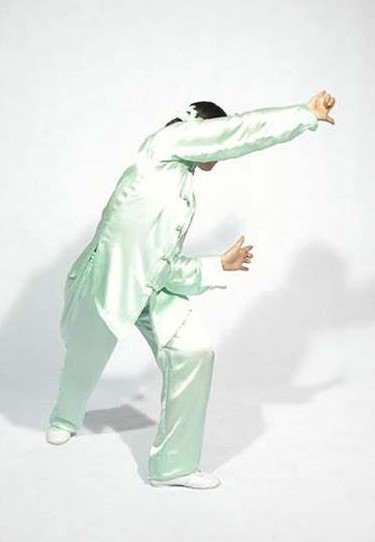
Deer Play: the deer belongs to water element, corresponding to the Kidney as its primary organ.
TCM states that “the kidney governs bones and generates marrow.” The deer’s “running and leaping” (as in “Deer Runs”) relies on strong bones and muscles, directly reflecting the kidney’s bone-nourishing function. Meanwhile, the deer’s “lightness and agility” (as in “Deer Turns”) depend on the kidney’s role as the “controller of movement” for the entire body . Deer Play emphasizes calmness and reaching-up postures, such as “Deer Turns” (waist twisting with alternating hand movements) and “Deer Runs” (sitting back and stretching forward to form a bow-shaped spine). These motions align with Water’s “moistening and flowing downward” nature, helping nourish kidney yin and warm kidney yang .
Through imitating the deer’s vitality and stability, Deer Play focuses on strengthening kidney function. It reinforces the waist and bones, warms kidney yang, and enhances the kidney’s essence-storing capacity via focused movements like “looking backward,” thereby preventing lower back pain and fatigue .

Bear play: Bear belongs to the earth, mainly train the muscles and the spleen-stomach. The body of bear is dull, vigorous and calm, with a big inner strength and a heavy shape and inner dexterity. It mainly imitates bear’s steady body shaking and other actions. For example, bear shakes its body with spiral tightening, moves its whole body with shoulder collar spine, moves its elbow, wrist, hip, knee, ankle and other parts completely, that is, pulls the whole body to start. Bear play practice can strengthen the spleen and liver, promote digestion, good sleep, strengthen limbs muscles, increase strength, flexible joints. Constant exercise to prevent spleen deficiency, liver and spleen enlargement, diabetes, constipation, gastroptosis, excessive gastric acid, duodenal ulcer, rectoanal prolapse, etc.


Ape play: ape or monkey belongs to fire, mainly train the brain and heart. The nature of ape is like moving not like quiet, good at climbing, jumping, hiding. Imitate the ape’s jump up and down, left and right looking at the action, keep mind at Lao-gong point. Externally exercise the flexibility of body, internally exercise the turbulence of restraint sentiment. Ape practice heart, mind-heart control blood-vein. Practice of ape play can nourish the heart and brain, become healthy and wise, dreg blood and enhance spirit, prevent forgetfulness, cerebrovascular disease, cerebral thrombosis, anemia, etc.

Bird play: The bird belongs to metal, mainly train skin and lung. Here bird refers to a kind of long-lived bird represented by crane. Its limbs are light, good at migration, good at flying high, and enjoy quarrel, with a high degree of balance. To imitate the movement of spreading wings to fly and keep mind at “Qi-hai point” (lower dantian), it can regulate qi and blood, increase vital capacity, enhance lung function, dredge channels and collaterals, and flexible joints. The eyes of the crane is always looking around, moving, looking around, and what is the function of the eye of the bird? It is the function of the lungs. When it ACTS in conjunction with movements, such as flying crane, when it is lifted, all the viscera rise up, when it falls down, all down, and return to normal. Such an upper and down, open and closure, the internal organs especially the lungs play important function. Practice of bird play can improve lung function, strengthen muscle surface, nourish Yin and moisten lung, clear heat and relieve heat, open chest and regulate qi. With possible healing and prevention from tuberculosis, night sweats, arthritis, heart tingling, wheezing cough, etc.

Clinical Studies on the Health Benefits of Wuqinxi (Five-Animal Plays)
Modern research has increasingly focused on validating the health benefits of Wuqinxi through clinical studies. These investigations examine its effects on specific physiological indicators and chronic diseases, providing scientific support for its traditional claims of promoting organ health and overall well-being .
1. Musculoskeletal and Motor Function Improvements
- Chronic Low Back Pain: A randomized controlled trial demonstrated that a 24-week Wuqinxi intervention significantly reduced pain intensity and improved trunk muscle strength in patients with chronic low back pain. The exercise group showed enhanced electromyographic activity in core muscles (e.g., obliquus externus abdominis) and better long-term pain relief compared to general exercise .
- Knee Osteoarthritis (KOA): Studies indicate that Wuqinxi improves proprioception, dynamic balance, and knee flexibility in middle-aged and elderly women with KOA, reducing fall risks and enhancing joint stability .
2. Cardiovascular and Metabolic Health
- Hypertension and Lipid Metabolism: Regular practice has been linked to reduced blood pressure, improved lipid profiles (e.g., lower triglycerides and LDL cholesterol), and enhanced vascular elasticity in elderly populations .
- Chronic Heart Failure (CHF): In patients with CHF (Qi-Yin deficiency with blood stasis syndrome), Wuqinxi improved left ventricular ejection fraction, 6-minute walking distance, and quality of life by promoting circulation and reducing cardiac burden .
3. Respiratory System Enhancements
- Pulmonary Function: Wuqinxi’s emphasis on deep, rhythmic breathing (e.g., in Deer and Bird exercises) increases diaphragmatic movement, tidal volume, and oxygen exchange efficiency. Studies note significant improvements in lung capacity and alleviation of symptoms in chronic obstructive pulmonary disease (COPD) patients .
4. Mental Health and Cognitive Benefits
- Depression and Sleep Disorders: As a mind-body exercise, Wuqinxi reduces anxiety, improves sleep quality, and alleviates mild depressive symptoms by regulating neurotransmitters (e.g., serotonin) and promoting relaxation .
- Cognitive Function: Research suggests enhanced attention span and memory in older adults, possibly due to improved blood flow to the brain and stress reduction .
5. Metabolic and Immune System Regulation
- Type 2 Diabetes and Fatty Liver: Wuqinxi aids glycemic control and blood lipid regulation, with studies showing reduced insulin resistance and liver fat content .
- Immunity: Long-term practice modulates T-cell activity and increases immune globulin levels, potentially slowing age-related immune decline .
Mechanisms of Action — Wuqinxi integrates three core elements—body movement (joint flexibility and muscle strength), breath control (enhanced oxygenation), and mental focus (nervous system regulation)—to activate the body’s self-healing capabilities. Its low-intensity, rhythmic nature aligns with aerobic exercise principles, making it suitable for diverse populations .
If you are interested in learning and practicing the Five-animal Play with us, please join our Weekly Qigong for Health class online by Zoom, every Sunday morning 9—10:30am in November~December of 2025.
https://www.eventbrite.com/e/dr-chens-weekly-online-qigong-for-health-a-zoom-based-event-tickets-101852467472
Or email to Allwyn at alja78@aol.com for more details.
For more information about Dr. Chen’s online Qigong for Health, please go to: